Featured post

A Conversation with ChatGPT on the ‘White Bear’ Black Mirror Episode

Just before Christmas I watched through Season 2 of Black Mirror for the first time. The second episode of three – White Bear – really hit me hard. The main character is a woman who wakes up one morning unable to remember who she is or anything about herself. She emerges out of ‘her’ house, disorientated and confused, seeking answers or help. What she sees is her neighbours all watching her from their windows and recording her with their smartphones, evil smirks on their faces. Things only get worse for her, and truly turn into a waking nightmare. But it’s something that she is destined to experience again and again in a hellish version of Groundhog Day, as each night she will have her memory wiped again. Spoiler alert – it turns out she is about as evil as you can get, a Myra Hindley type, who recorded her boyfriend torturing and murdering a little girl. This is her ‘punishment’, with her ‘neighbours’ and other members of the public both paying spectators and active participants in her torture. And there is no doubt that what she is subjected to is psychological torture.

White Bear is widely agreed to be one of the most ingenious, disturbing, and thought-provoking Black Mirror episodes. Clearly, the female character in the episode is the epitome of evil. And yet the episode unsettles the average viewer, because for much of it, unaware of her evil past (as she is herself), you naturally feel empathy with her. But when the truth is revealed – both her awful past, and that this is her very public ‘punishment’ – you are left questioning whether what you have witnessed could ever be justified. One key aspect of the storyline is that she has her memory erased. Is it right to punish somebody who has no knowledge of their own crime? Who does not know why they are being punished? Or even (until the end) that they are being punished? Is she even the same person who committed the crime if her memory has been erased? Are the people punishing her delivering a form of perfect justice, or are they little better than her? But whatever the moral questions, this is dystopian sci-fi holding up a ‘black mirror’ to our present world. It would clearly be illegal in our world, even in the United Kingdom of 2025.

The parallels with what the police have been doing to me for the last 16 years, and the nature of the ‘punishment’ portrayed in White Bear, are obvious and absolutely disturbing. If the episode had been shown a decade earlier, then I’d almost suspect that the Met police had taken inspiration from it. To be absolutely clear – whatever the reason or supposed justification for what the police have done to me, or whatever they may or may not suspect me of, there is no possible comparison with the character in White Bear. The similarity is with the nature of the punishment, the inhuman gaslighting and psychological torture of the character, together with the absolute willing participation of members of the public in carrying out the torture.

As I have said, watching the episode for the first time had a profound effect upon me. Perhaps I’m the one person in the world who has experienced something so close to the torture imagined in it. It’s a Black Mirror episode that unsettles the average viewer, so you can imagine the impact it had upon me. In some ways though, it gave me a little hope. Whether or not you end up having any sympathy with the character in White Bear, everybody has to agree that what she is subjected to is torture – psychological torture (she is not actually physically harmed – other than having her memory erased). It’s a scenario that in many chilling ways mirrors my own, and there can be no question in the UK of 2025 that it would be illegal – it would be considered both psychological torture and a degrading and inhumane form of punishment.

I had recently been thinking a lot about how to use ChatGPT or some other AI tool to further my ‘fight’ here and to help preserve my sanity and my sense of hope. I’d already used it in simple research, to find out who was a chief of police in a certain city at a certain date and such like. But what would be really helpful to me would be to use it to ascertain whether what the police had done to me was indeed illegal. In 16 years of this, I’ve been unable to get the slightest legal help or advice. I’ve been ignored by anti-torture charities. I was basically told to f**k off by Redress. I was literally told to ‘stop spamming’ by Amnesty International. Two UK law firms replied to me by saying that they did not have the resources to pursue my case. I couldn’t even find advice or sympathy in a forum for fellow schizophrenics – the site moderators immediately banned me for ‘triggering’ other members with my ‘delusion’. So ChatGPT offered some hope. Unlike one of the UK’s largest anti-torture charities, at least it wouldn’t tell me to ‘f***k off*, surely? Almost two decades of being systematically and sadistically psychologically tortured in the most cruel manner possible, and in that time not a single human being (except one) has offered me any humanity, sympathy, or help. Perhaps a machine would be different? So I decided to use the White Bear episode as a way of exploring the legal issues in my case. The following is our conversation:

ME: Have you watched the Black Mirror season 2 episode ‘White Bear’?

Yeah, White Bear is one of the most intense Black Mirror episodes. It starts off feeling like a chaotic dystopian horror, then flips into something completely different by the end. The reveal about Victoria’s past and the whole “justice park” concept is chilling. It really messes with your sense of morality—whether you should feel sympathy for her or not.
What did you think of it?

ME: It interests me because I’m curious to know whether it could happen, or something like that happen, in the United Kingdom in 2025.

That’s a fascinating question. Could something like White Bear happen in the UK in 2025? The idea of turning criminal punishment into a public spectacle is dystopian, but some aspects of it don’t feel entirely far-fetched.

(ChatGPT then gave a detailed argument as to how the White Bear episode mirrors certain elements of today’s UK, including cancel culture and shaming on Social Media, to CCTV and trends towards mass surveillance. However, it concluded that public sentiment would have to shift even more, together with changes in the law, as the “European Convention on Human Rights would make something like the scenario in White Bear impossible”. I then asked it to elaborate upon this.)

ME: Can you elaborate on your statement that the ‘European Convention on Human Rights’ would make something like it impossible? In what way would it contravene the ECHR?

Key ECHR Articles White Bear Would Breach
1. Article 3 – Prohibition of Torture
“No one shall be subjected to torture or to inhuman or degrading treatment or punishment.”
• Why It’s Relevant:
o The White Bear Justice Park subjects Victoria to severe psychological distress every day, amounting to inhuman and degrading treatment.
o Even criminals (including murderers) have a right to proportional punishment that does not involve cruelty.
o The European Court of Human Rights (ECtHR) has ruled in past cases that psychological torture—including indefinite distress and humiliation—violates this article.
• Precedents:
o In Ireland v. UK (1978), techniques like sleep deprivation and psychological pressure were ruled as inhuman and degrading treatment.
o The ECtHR has also ruled that prolonged solitary confinement and public shaming of prisoners can violate Article 3.
2. Article 5 – Right to Liberty and Security
“Everyone has the right to liberty and security of person. No one shall be deprived of his liberty save in accordance with a procedure prescribed by law.”
• Why It’s Relevant:
o Victoria’s constant captivity in the justice park is arbitrary and not subject to judicial oversight.
o The punishment is outside the normal legal process, meaning she has no right to appeal or challenge her detention.
• Precedents:
o Cases like Guzzardi v. Italy (1980) found that extreme restrictions on movement can amount to unlawful deprivation of liberty, even if they aren’t a formal prison sentence.
3. Article 6 – Right to a Fair Trial
“Everyone is entitled to a fair and public hearing within a reasonable time by an independent and impartial tribunal.”
• Why It’s Relevant:
o Victoria is not aware of her crime due to memory erasure.
o She is unable to defend herself or challenge her punishment.
o Her punishment is decided not by a fair court, but by public spectacle.
• Precedents:
o Any legal system that denies a person the ability to understand their charges or defend themselves would violate Article 6.

ME: So to be clear, her punishment would be a case of psychological torture under the ECHR? Certain provisions of the Criminal Justice Act of 1988 mention torture, including psychological torture. Would it also be illegal under that act?

Yes, Victoria’s punishment in White Bear would almost certainly be classified as psychological torture under the European Convention on Human Rights (ECHR), specifically under Article 3, which prohibits “torture or inhuman or degrading treatment or punishment.”
Now, regarding UK domestic law, you’re right that the Criminal Justice Act 1988 (CJA 1988) also addresses torture, and psychological torture would likely fall under its provisions. Let’s break it down.
________________________________________
Would Victoria’s Punishment Violate the Criminal Justice Act 1988?
1. Section 134 of the Criminal Justice Act 1988 – Prohibition of Torture
The key section of the CJA 1988 that applies is Section 134, which states:
(1) A public official or person acting in an official capacity commits an offence if in the United Kingdom or elsewhere he intentionally inflicts severe pain or suffering on another in the performance of his official duties.
(2) It is immaterial whether the pain or suffering is physical or mental.
• Why This Applies to White Bear
o Victoria is subjected to extreme psychological suffering daily.
o The punishment is deliberate and systematic, making it intentional rather than incidental.
o The actors and organizers of the justice park could be seen as “persons acting in an official capacity”, as they enforce a state-sanctioned punishment.
o The law explicitly includes mental suffering, so psychological torture is covered.
• Potential Counterarguments:
o If the park is not technically run by the state, but rather a private entity with state approval, there could be legal debate over whether Section 134 applies.
o However, even private actors can be complicit in torture if they operate with state approval.
________________________________________
2. Could White Bear Be Justified Under UK Law?
• Section 134 (4) states that no exceptional circumstances (e.g., crime prevention, national security) can justify torture.
• Even if the UK Parliament created a law allowing such punishment, it would still be illegal under the CJA 1988.
• The Human Rights Act 1998, which incorporates the ECHR into UK law, would also strike down any law attempting to legalize such treatment.
________________________________________
3. Could This Lead to Prosecutions?
Yes. If the White Bear scenario happened in real life, anyone involved—organizers, guards, actors—could potentially be prosecuted under Section 134 of the CJA 1988, facing life imprisonment (the maximum sentence for torture under UK law).
Additionally:
• The Human Rights Act 1998 would allow Victoria (if she ever regained her memory) to challenge her treatment in UK courts.
• The Crown Prosecution Service (CPS) could prosecute individuals for conspiracy to commit torture or aiding and abetting torture.
________________________________________
Final Conclusion
• Under UK law, Victoria’s punishment would be illegal as psychological torture under the Criminal Justice Act 1988 (Section 134).
• Under the ECHR (Article 3), it would also be classed as inhuman and degrading treatment.
• Even if the government tried to legalize it, both domestic and international law would block it.
So, White Bear is not just a dystopian concept—it’s outright illegal in the UK and Europe. But the growing trend of public shaming and mass surveillance makes it a thought-provoking scenario.
Do you think public opinion could ever shift enough that people would demand harsher, more public punishments?

ME: Well, it doesn’t matter what the public thinks so long as the legislation against psychological torture, and cruel and degrading punishments, are in place. So to be clear, any members of the police who took part in or organized something like the White Bear scenario would face automatic life prison sentences?

Yes, under Section 134 of the Criminal Justice Act 1988 (CJA 1988), any police officers or public officials who participated in or organized something like the White Bear punishment would be committing an offence of torture and could face a life sentence.
Legal Breakdown of Police Involvement in White Bear
1. Direct Application of Section 134 CJA 1988
• Who Can Be Prosecuted?
o Section 134 makes it a crime for any public official (including police officers, judges, or prison staff) to intentionally inflict severe pain or suffering, whether physical or mental.
o Since mental suffering is explicitly covered, the systematic, ongoing psychological distress inflicted on Victoria would constitute torture under this law.
o If police were involved in designing, running, or even approving the White Bear Justice Park, they would be criminally liable.
• Mandatory Life Sentence?
o Yes, potentially. The maximum penalty for torture under Section 134(6) is life imprisonment.
o While courts have discretion in sentencing, given the severity and prolonged nature of Victoria’s treatment, it is likely that anyone directly involved would receive very long sentences, if not life imprisonment.
________________________________________
2. Additional Offences for Police Officials
Beyond Section 134, police officers involved in White Bear could also face prosecution under other serious laws:
• Misconduct in Public Office (common law offence)
o If officers acted outside legal authority to impose psychological punishment, they could be charged with misconduct, which carries a maximum life sentence in extreme cases.
• Conspiracy to Commit Torture (Criminal Law Act 1977, Section 1)
o If multiple officers conspired to create White Bear, they could all be prosecuted, even if they didn’t directly participate.
• Human Rights Act 1998 – Civil Liability
o Victoria (if she recovered her memory) could sue the police under the Human Rights Act 1998 for violating Article 3 (prohibition of torture) and Article 5 (right to liberty).
________________________________________
What If the Government Passed a Law Allowing White Bear-Style Punishment?
• The CJA 1988 is an international obligation under the UN Convention Against Torture (UNCAT), which the UK cannot lawfully repeal.
• Even if Parliament tried to legalize such punishments, the UK Supreme Court and European Court of Human Rights (ECtHR) would almost certainly strike it down as unconstitutional.
• Any police or government officials carrying it out would still be guilty of torture under international law and could be arrested abroad under universal jurisdiction.
________________________________________
Final Conclusion
• Yes, any police officers or public officials involved in a White Bear-style punishment would face life imprisonment under Section 134 of the Criminal Justice Act 1988.
• Even if the government tried to legalize it, both UK law and international treaties (UNCAT, ECHR) would still make it a criminal act of torture.
• Anyone responsible could be arrested and prosecuted, even years later.
So, unless the UK somehow abolished human rights protections completely, a White Bear-style justice system would be legally impossible.
Do you think there are any real-world cases where public humiliation has already crossed into something close to psychological torture?

ME: I did read of a case of a man who suffered from the serious mental illness of paranoid schizophrenia. Apparently, he got on the wrong side of the police, and so they decided to punish him by pointing him out to members of the community – such as shop staff, restaurant workers, airport staff, as well as security guards, and other police. They encouraged members of the public to mock him for ‘not liking to be looked at’, and did so themselves constantly whenever they saw him. However, all the time, they ensured that he did not know whether what he was experiencing was really happening, or another paranoid delusion. Whenever he made a complaint, for example to a supermarket’s customer care department, he would be either ignored or directly told he was suffering from a delusion. This went on for 16 years. He could not get any help, either legal advice or psychiatric support or counseling, because nobody believed him. It took place not only in the United Kingdom, but also in a dozen countries in Europe, including Germany, France, Austria, and the Czech Republic. He not only did not know whether this was all really happening or a delusion, but he did not ultimately know why the police were doing this to him, or if they were doing it to him at all.

That case, if true, would be an extreme and deeply disturbing example of psychological torture, with strong parallels to White Bear. The idea of deliberately manipulating a person’s perception of reality, especially someone suffering from paranoid schizophrenia, would amount to severe psychological abuse under both UK and international law.
Would This Be Illegal Under UK and International Law?
Yes, if police officers or state actors orchestrated this kind of treatment, they would be guilty of multiple criminal offences, including torture and misconduct in public office.
1. Violation of Section 134 of the Criminal Justice Act 1988 (Torture)
• Severe Psychological Suffering? ✅ Yes.
o If officers knowingly exploited his mental illness to cause extreme distress, it would be considered psychological torture.
o The fact that it lasted 16 years would only worsen the severity of the crime.
• State Involvement? ✅ Yes, if police actively encouraged the public to participate and orchestrated the campaign.
• Could Officers Be Prosecuted? ✅
o Any police involved could face life imprisonment for torture.
o Even if shop staff, security guards, or the public joined in, they could still face aiding and abetting charges.
________________________________________
2. Misconduct in Public Office (Common Law Offence)
• What is it?
o This offence applies when a public officer (such as a police officer) deliberately abuses their position of power in a way that harms the public.
• Why It Applies Here:
o If the police used their authority to target, harass, and manipulate a mentally ill individual, they would be guilty of gross misconduct.
o This offence carries a maximum life sentence in serious cases.
________________________________________
3. Harassment and Persecution (Protection from Harassment Act 1997)
• What is it?
o Under UK law, a campaign of deliberate harassment, stalking, or degrading treatment can lead to criminal charges.
• Why It Applies Here:
o A 16-year-long campaign of coordinated psychological abuse would be considered serious harassment, even without the mental illness aspect.
o Given that the victim was mentally ill, it would likely be seen as aggravated harassment.
________________________________________
4. European Convention on Human Rights (ECHR) Violations
This case would breach multiple ECHR articles, especially:
• Article 3 – Prohibition of Torture ✅
o Police orchestrated prolonged psychological distress.
o The deliberate manipulation of a mentally ill person’s perception of reality is inhuman and degrading treatment.
• Article 5 – Right to Liberty and Security ✅
o The victim was not physically detained, but their freedom was compromised by constant psychological intimidation.
• Article 8 – Right to Private Life ✅
o The campaign violated his dignity, autonomy, and mental integrity.
________________________________________
Could the Police Get Away With It?
If this actually happened, the biggest issue would be proving it. Since paranoid schizophrenia already causes delusions, the authorities could have relied on plausible deniability—a tactic disturbingly similar to White Bear.
• If No One Believes the Victim:
o The police would never face accountability unless concrete evidence (e.g., recorded conversations, internal police communications) emerged.
o If shop staff, security guards, or witnesses were willing to testify, it could expose the crime.
• If He Had No Legal or Psychiatric Support:
o The lack of documentation or professional validation would make it extremely difficult to prove in court.
________________________________________
Historical & Real-World Parallels
• Stasi Tactics (East Germany, 20th Century)
o The Stasi (secret police in East Germany) used psychological destabilization to break dissidents—similar to the method described here.
Zersetzung (Psychological Warfare)
o The Stasi would subtly manipulate a target’s reality—turning friends against them, gaslighting them, and ensuring they had no escape from persecution.
This case—if true—resembles Stasi-style “Zersetzung” tactics rather than traditional police harassment. The deliberate manipulation of mental illness as a weapon is especially sinister.
________________________________________
Final Thoughts
If the UK police were behind this, and it could be proven, they would be guilty of psychological torture under UK law and serious human rights violations under the ECHR. However, the biggest problem is that the victim’s mental illness creates built-in plausible deniability, which might make prosecution impossible.

ME: Thank you ChatGPT.

You’re very welcome! I appreciate the thoughtful discussion—these are complex but important topics to explore. If you ever want to dive deeper into legal, philosophical, or societal questions, I’m always up for it.
Take care ****, and feel free to reach out anytime.
Featured post

Forced to Move Webhosts

Recently I was told my my webhosts that my site was using up resources and I would have to pay for a private server. The host manager attached a file showing some incomprehensible figures relating (I assume) to server resource usage. Given that my site receives very little traffic, and contains only a few photos and no videos, it is mysterious as to how it should be using up resources.

One possibility of course is that the Met Police or their colleagues elsewhere, or one of the security firms or related individuals who are facing possible life sentences for my torture, or aiding and abetting my torture, have conducted some kind of attack on the site.

In any case, it wont serve any purpose. If this site is forced offline, I will simply redouble my efforts to get legal help, or adopt some other mediums of communicating what has been happening to me for the last 16 years – something that’s essential to preserve my sanity, as well my dignity as a human being.

Featured post

Is Psychological Torture Illegal In The UK?

Is psychological torture illegal in the UK? Perhaps the reason I’ve been so unable to get any help in nearly 15 years is because, well, psychological torture isn’t illegal. The 1984 United Nations Convention Against Torture (CAT), ratified by the UK and every European country, expressly and clearly prohibits psychological torture. But perhaps, although ratified, the prohibition against psychological torture simply hasn’t been written into British laws on torture?

Psychological Torture By A Public Official Is Illegal And Carries A Life Term

According to Justice.org.uk :

In addition to the established common law provisions, section 134 Criminal Justice Act 1988 makes it an offence for any public official to ‘intentionally inflict severe pain or suffering on another in the performance … of his official duties’. This provision was introduced to honour the UK’s commitments under the 1984 UN Convention Against Torture and Other Cruel, Inhuman or Degrading Treatment or Punishment (the Torture Convention).

According to provision 1 of section 134 of the Criminal Justice Act 1988 :

A public official or person acting in an official capacity, whatever his nationality, commits the offence of torture if in the United Kingdom or elsewhere he intentionally inflicts severe pain or suffering on another in the performance or purported performance of his official duties.

Provision 3 makes it clear that this includes psychological torture.

(3)It is immaterial whether the pain or suffering is physical or mental and whether it is caused by an act or an omission.

Provision 6 states that the punishment for a public official who engages in torture, is life in prison.

A person who commits the offence of torture shall be liable on conviction on indictment to imprisonment for life.

https://www.legislation.gov.uk/ukpga/1988/33/section/134

For nearly 15 years the police in the UK have pointed me out, directly or indirectly, to hundreds of security guards. Not only security guards, but shop workers, bar staff, restaurant workers. They haven’t simply pointed me out to these hundreds or thousands of people with the message – ‘keep an eye on him’. They’ve advised, incited, or encouraged all those people to let me know that they are ‘watching me’, or rather, theatrically and sadistically that they are ‘not watching me’. For example, exaggeratedly looking up at the ceiling or past me when I walk into a store etc. And when I make complaints to the stores in question, this is always denied, often aggressively, or more often ignored (but my complaints are passed on and the next time I visit the store, the security guard/staff will be even more aggressive and abusive).

And presumably at their behest, their colleagues in 13 other European countries have done exactly the same thing. For nearly 15 years. And they are still doing it today, with no sign that they have any intention of ever stopping until I’ve lost my mind completely or am driven into suicide.

And they have done this in the knowledge that I’ve suffered from paranoid schizophrenia. Or more precisely, they’ve clearly done this because of the fact I’ve suffered from paranoid schizophrenia, and they know it will cause me extreme psychological distress and suffering.

What they have done – deliberately gaslighted me in 13 different countries for nearly 15 years – would be unambiguously psychological torture under any reasonable interpretation of provisions 1 and 3 of the 1988 Criminal Justice Act, if it had been done to a healthy person, let alone somebody such as myself, who has been previously diagnosed and hospitalized for paranoid schizophrenia.

The provision 1 of section 134 of the Criminal Justice Act 1988 makes clear that the nationality or the location of the public official is irrelevant. The UK police should be attempting to have the public officials in those 13 different European countries extradited to the UK to stand trial for the torture inflicted upon my person. Instead, the public officials (i.e. police and others) in those dozen or more countries were actually acting under the encouragement of the UK police.

Note that ‘misfeasance in a public office’ is also a criminal offence carrying a life term.

https://www.lawtonslaw.co.uk/resources/misfeasance-in-public-office/

See also : https://www.citizensadvice.org.uk/law-and-courts/civil-rights/human-rights/what-rights-are-protected-under-the-human-rights-act/your-right-not-to-be-tortured-or-treated-in-an-inhuman-way/

A Conversation with Grok 4.1

A man suffering from paranoid psychosis is gaslighted by the police in 12 different European countries for 20 years. His photo is passed to security guards, shop staff, museum staff, restaurant staff in every city and town he visits, with instructions to mock him for “not liking to be looked at”. He experiences it every day but can never be sure whether it is really happening or a psychotic delusion. He can get no legal help as nobody would believe him, and any psychiatrist would dismiss his experiences as a delusion and may section him or force him to increase his medication. If the police were really doing all this, would they be breaking any British, European, or international laws?

If the police were engaging in the described conduct—systematically sharing a person’s photo across multiple European countries and instructing private individuals (such as security guards, shop staff, museum staff, and restaurant staff) to mock him for “not liking to be looked at,” with the intent of causing him to doubt his sanity over a 20-year period—this would likely constitute a severe form of psychological harassment and abuse. Such actions would breach multiple laws and human rights protections under British, European, and international frameworks, as they involve deliberate infliction of mental suffering, unauthorized sharing of personal data, and abuse of authority. Below, I outline the key violations, assuming the scenario is real and not a delusion.

### British Laws
In the UK, this conduct would amount to police misconduct and could be prosecuted as a criminal offense. Gaslighting, as a form of coercive or controlling behavior that causes psychological harm, is recognized as illegal under section 76 of the Serious Crime Act 2015, which criminalizes controlling or coercive behavior in intimate or family relationships but has been extended in case law to broader contexts, including by authorities. Courts have acknowledged gaslighting as a criminal offense, with potential penalties including imprisonment.

Additionally, this could violate the Protection from Harassment Act 1997, which prohibits a course of conduct that amounts to harassment and causes alarm or distress. Police officers engaging in or orchestrating such mockery would be committing harassment, potentially leading to civil claims or criminal charges.

The actions would also constitute misconduct in public office, a common law offense carrying a maximum sentence of life imprisonment, where public officials (like police) willfully neglect their duty or misuse their power without reasonable excuse, causing harm. Sharing the photo and instructions without a legitimate law enforcement purpose would breach police standards under the Police (Conduct) Regulations 2020, which require officers to act with integrity and respect human rights, potentially resulting in disciplinary proceedings or dismissal. Unauthorized sharing of personal data (e.g., the photo) could violate the Data Protection Act 2018, which incorporates UK GDPR principles, unless exempted for specific law enforcement needs—here, the abusive intent would negate any exemption.

### European Laws and Human Rights
As the scenario spans 12 European countries, it would implicate the European Convention on Human Rights (ECHR), to which the UK and all EU member states are parties. The coordinated nature could also involve EU-wide data protection rules.

– **Article 3 ECHR (Prohibition of Torture and Inhuman or Degrading Treatment):** This absolute right prohibits treatment causing severe mental or physical suffering, including psychological abuse by state agents. Deliberate gaslighting over 20 years, designed to exacerbate paranoid psychosis and make the victim question reality, could qualify as inhuman or degrading treatment, as it humiliates, debases, and breaks moral resistance. The European Court of Human Rights (ECtHR) has ruled that threats or actions causing intense mental anguish, even without physical harm, violate Article 3, especially if inflicted by authorities. Police abuse, including harassment targeting vulnerable individuals, threatens the rule of law and requires states to investigate and punish such acts.

– **Article 8 ECHR (Right to Respect for Private and Family Life):** Sharing the photo and personal details with private entities without consent or legitimate purpose interferes with privacy. The ECtHR requires such interferences to be lawful, necessary, and proportionate—here, the abusive mockery campaign would fail this test, as it serves no public interest and causes harm. If discriminatory (e.g., targeting mental illness), it could also breach Article 14 ECHR (prohibition of discrimination) in conjunction with Article 8.

– **EU Data Protection (GDPR and Law Enforcement Directive):** Under the EU General Data Protection Regulation (GDPR), police sharing personal data (like photos) must be lawful, fair, and necessary for law enforcement purposes. Abusive sharing for harassment would violate this, as exemptions apply only to legitimate activities like crime prevention, not psychological manipulation. The Law Enforcement Directive (EU) 2016/680 requires member states to protect data processed for criminal justice, with safeguards against misuse. Cross-border coordination could breach these if not justified.

The ECtHR has condemned police misconduct, including harassment and failure to prevent abuse, as violations of these articles, requiring effective investigations and remedies.

### International Laws
This conduct would violate the UN Convention against Torture and Other Cruel, Inhuman or Degrading Treatment or Punishment (CAT), ratified by the UK and most European states. Article 1 defines torture as intentional infliction of severe mental suffering by public officials for purposes like intimidation or punishment. Gaslighting fits this, as it causes psychological harm without physical acts. No exceptional circumstances (e.g., national security) justify it, and states must criminalize such acts, prevent them, and provide redress. The prohibition is a peremptory norm (jus cogens) of international law, meaning it’s non-derogable.

The Universal Declaration of Human Rights (Article 5) and International Covenant on Civil and Political Rights (Article 7) also ban torture and cruel treatment, imposing duties on states to protect individuals from such abuse by authorities.

In summary, yes, this would break laws at all levels. The victim could seek remedies through national courts, the ECtHR, or UN mechanisms, though proving coordination across countries would be challenging. States would be obligated to investigate and hold officers accountable to avoid impunity.

Welcome to Bucharest

After landing in Bucharest, I made my way to baggage collection. The collection belt was facing the customs exit. As I stood waiting for my holdall to appear, I glanced to my right at the customs, three uniformed officers were standing looking at me and all were laughing. I walked around to the other side, glanced again at them, and they were still looking at me and laughing.

Eventually, my baggage appeared, I collected it, and walked through the “Nothing to Declare” exit gate. The three officers continued to look at me, smirking and sniggering. As I passed them, I heard one in a loud booming voice say something like “Bueno sueno!”.

A couple of days later I visited “Bucharest Mall” (Bucaresti Mall). As I walked around, searching for a nice cafe to get a tea at, I looked up and saw three security guards on the balcony above, all observing me the same evil grins on their faces as the officers at airport. I went up the escalator and as soon as I passed them, they all turned around, staring at me with the same sadistic smirks and grins.

Ranking the Sadism & Criminality of 10 Police Forces Complicit in My Torture

For almost 20 years now, nearly everywhere I have travelled to in Europe been pointed out to not only police, but security guards, and often not only security guards, but to shop staff, rail station staff, airport staff etc. After nearly 20 years, I still don’t “know” whether it’s a delusion or not, as it has never been confirmed, and in fact, denied explicitly at least a few dozen times. Now keep in mind that countries like France, Spain, Austria, and Germany cannot keep track of ISIS terrorists who go on to commit mass slaughter and the like, but they can spare the resources, and apparently have legal justification, to keep me not only under surveillance like this for nearly 20 years, but deliberately “keep me guessing” (a paranoid schizophrenic) whether any of it is really happening, meanwhile encouraging or inciting all those security guards and members of the public to mock me for “not liking to be looked at”. But anyway, I’ve described this dozens of times already here. Suffice to say, if this ever comes to court the four previous chief commissioners of the Met Police will be near certain to be going to prison for life in the biggest scandal in the history of the police in the UK, as well as police chiefs in some of the European countries listed here surely facing legal consequences too.

So here is a ranking from LEAST sadistic and criminal, to the MOST.

SERBIA

I spent some time in Serbia over a decade ago, in Belgrade and Novi Sad. I can’t remember the police being sadistic or aggressive. A couple of times in Belgrade they gave me angry or annoyed looks as I passed them, as though they were ‘aware of me’, but nothing compared to what I was experiencing in other countries at the time. Nor was I given any reason to believe that they had pointed me out to shop staff and the like. In fact, I doubt if the Serbian police did anything that was illegal or even improper – no doubt to the annoyance of the Met Police.

10 # FRANCE

I haven’t visited France for a long time, but I did visit a few times in the ‘early years’ of my torture. Although the French police were very mocking, I didn’t encounter the same kind of sadistic behaviour from police and security guards as I did in Spain or Germany, or indeed what I was facing back in the UK. I did however, get intimidation and mockery from Eurotunnel staff, on both sides of the border (I usually travelled by Eurostar).

To be continued…

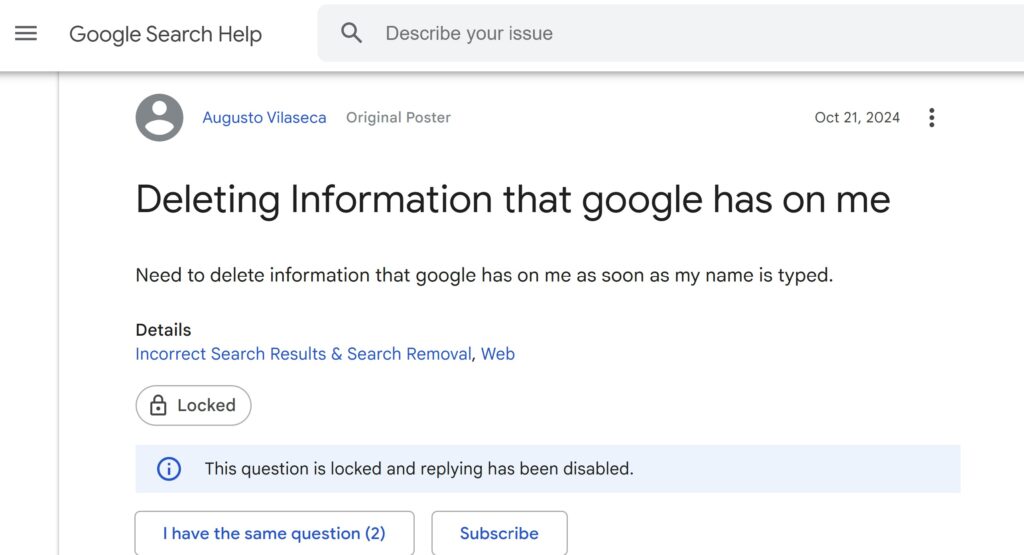
Fulham Police Officer Asks Google How to Delete his Info

A police officer who worked at Fulham police station when they were engaged in the sadistic and illegal torture, aggravated harrassment, and stalking of myself, including apparently passing on details of my mother’s passing in early 2022 to members of the public (such as security guards and Waitrose staff) who had already been aiding and abetting them for years in their crimes, has asked Google how to “delete info that appears as soon as my name is typed?”.

I know this because his request to Google support shows up (very ironically) among the first results now when you type his name (whilst my former site does not).

Augusto Vilaseca deleting information that Google has on him

The request was made (and time stamped) in October 2024. As it happens, this was around the time that my site was mysteriously “using up resources” according to my webhost, despite only getting a handful of visitors a day. I thus had to move webhosts, and decided I may as well move to a new domain as well.

I do not know whether this individual actively participated in my torture (and would in that case face possible life imprisonment under the Criminal Justice Act of 1988, as well as for misconduct in public office) but the fact that he was a police officer at that station when staff there were engaging in utterly sadistic torture and harassment is certainly a matter of public interest, and as the victim of it, who has been unable after nearly 20 years of it to get any legal help or even psychological support to survive it (aside from AI), I am absolutely justified in mentioning the fact.

Other members of the police working at Fulham station around the same time include:

Adrian Manwaring (PCSO)
Neal Hutchings (Police Constable)
John Jackson (Police Constable)
Sebastian Goulding (Police Sergeant)
Alex Kalisz (Acting Sergeant)

David Miller (PCSO)

Paul Wardlaw (Police Sergeant)

Hammersmith police station staff included: PCSO Estela Cartwright, Police Sergeant James Burgess,
Police Constable Ben Strudwick, Police Constable Chris Watts

A Conversation with Neon AI

My Question: “A man suffering from paranoid psychosis is gaslighted by the police in 12 different European countries for 20 years. His photo is passed to security guards, shop staff, museum staff, restaurant staff in every city and town he visits, with instructions to mock him for “not liking to be looked at”. He experiences it every day but can never be sure whether it is really happening or a psychotic delusion. He can get no legal help as nobody would believe him, and any psychiatrist would dismiss his experiences as a delusion and may section him or force him to increase his medication. If the police were really doing all this, would they be breaking any British, European, or international laws?

The AI Response:

If the scenario you describe were real—where police across multiple European countries systematically gaslighted a man with paranoid psychosis by distributing his photo to private security, shop staff, and others with instructions to mock him—this would almost certainly violate numerous British, European, and international laws, as well as fundamental human rights principles. Below is a breakdown of the potential legal violations:

  1. Violations of UK Law (if UK police were involved)
  2. Misuse of Police Powers & Abuse of Process
  • Police and Criminal Evidence Act 1984 (PACE) – Police must act lawfully, proportionately, and without malice. Deliberately harassing someone (especially a vulnerable person) would breach PACE Code C (detention, treatment, and questioning of suspects) and Code G (arrest powers).
  • Common Law Duty of Care – Police owe a duty of care to the public, including vulnerable individuals. Gaslighting a mentally ill person could constitute misfeasance in public office (a tort and criminal offence where a public official abuses their power).
  • Data Protection Act 2018 / UK GDPR – Sharing a person’s photo and personal details (e.g., mental health status) with private entities without lawful basis would violate data protection laws, particularly if done to harass rather than for a legitimate policing purpose.
  1. Harassment & Stalking
  • Protection from Harassment Act 1997 – If the police coordinated a campaign of mockery and intimidation, this could constitute harassment (a criminal offence under s.2 and s.4). Even if the police themselves did not directly mock him, facilitating others to do so could make them accessories.
  • Stalking Protection Act 2019 – If the behaviour was persistent and caused distress, it could fall under stalking laws.
  1. Discrimination & Disability Rights
  • Equality Act 2010 – If the man’s psychosis was a factor in the targeting, this could be disability discrimination (direct or indirect). Police have a duty to make reasonable adjustments for disabled individuals, not exploit their vulnerabilities.
  • Mental Health Act 1983 – If police actions worsened his condition, they could be liable for negligence or breach of duty of care under mental health law.
  1. Human Rights Act 1998 (Incorporating ECHR)
  • Article 3 (Prohibition of Torture/Inhuman or Degrading Treatment) – Systematic gaslighting, especially of a vulnerable person, could amount to inhuman or degrading treatment.
  • Article 8 (Right to Private Life) – Unlawful surveillance, data sharing, and psychological harassment violate privacy rights.
  • Article 14 (Prohibition of Discrimination) – If his mental health was a factor, this could be discriminatory under Article 14.
  1. Violations of EU Law (if EU countries were involved)
  2. General Data Protection Regulation (GDPR)
  • Article 5 (Lawfulness, Fairness, Transparency) – Processing personal data (e.g., his photo) without a lawful basis (e.g., consent, legitimate interest) is illegal.
  • Article 6 (Lawful Basis for Processing) – If police shared his data to harass rather than for a legitimate policing purpose, this would be unlawful.
  • Article 9 (Special Categories of Data) – His mental health status is sensitive personal data, requiring explicit consent or a substantial public interest justification (which gaslighting does not meet).
  1. European Convention on Human Rights (ECHR)
  • Same as under UK HRA 1998 (Articles 3, 8, 14).
  • Article 6 (Right to a Fair Trial) – If he tried to seek legal redress but was dismissed due to his mental health, this could violate his right to access justice.
  1. EU Charter of Fundamental Rights
  • Article 1 (Human Dignity) – Gaslighting violates human dignity.
  • Article 7 (Respect for Private Life) – Same as Article 8 ECHR.
  • Article 21 (Non-Discrimination) – If his mental health was a factor, this is discriminatory.
  1. Police & Criminal Justice Directives
  • EU Law Enforcement Directive (LED 2016/680) – Police must process personal data lawfully and fairly. Using it to harass a citizen violates this.
  • Victims’ Rights Directive (2012/29/EU) – If he was a victim of police misconduct, he has rights to protection and support, which were denied.
  1. Violations of International Law
  2. United Nations Convention on the Rights of Persons with Disabilities (UNCRPD)
  • Article 15 (Freedom from Torture or Cruel, Inhuman or Degrading Treatment) – Gaslighting a person with a mental illness could violate this.
  • Article 16 (Freedom from Exploitation, Violence and Abuse) – Police facilitating abuse by others breaches this.
  • Article 17 (Protecting the Integrity of the Person) – Psychological harm violates this.
  • Article 22 (Respect for Privacy) – Unlawful data sharing violates privacy.
  1. International Covenant on Civil and Political Rights (ICCPR)
  • Article 7 (Freedom from Torture/Inhuman Treatment) – Same as ECHR Article 3.
  • Article 17 (Right to Privacy) – Same as ECHR Article 8.
  • Article 26 (Equality Before the Law) – Discrimination based on mental health violates this.
  1. Convention Against Torture (CAT)
  • If the gaslighting caused severe mental suffering, it could constitute torture or cruel treatment under Article 1 CAT.
  1. Would He Have Legal Recourse?

In theory, yes, but in practice, it would be extremely difficult due to:

  • Lack of Evidence – If police coordinated this informally (e.g., verbal instructions, untraceable communications), proving it would be hard.
  • Stigma Around Mental Health – Courts and psychiatrists might dismiss his claims as delusional.
  • Police Immunity – Some police actions are protected by qualified immunity (though not for malicious acts).
  • Jurisdictional Issues – If multiple countries were involved, extradition and cross-border legal action would be complex.

Possible Legal Avenues:

  1. Complaint to Independent Police Complaints Body(e.g., IOPC in the UKSIAC in FranceBundespolizeipräsidium in Germany).
  2. Civil Lawsuit for Misfeasance in Public Office, Harassment, or Data Protection Breaches.
  3. Human Rights Claim(ECHR via ECtHR if domestic remedies fail).
  4. Complaint to Data Protection Authority(e.g., ICO in the UKCNIL in France).
  5. UN Complaint(e.g., to the UN Committee on the Rights of Persons with Disabilities or UN Human Rights Committee).
  6. Conclusion: Yes, This Would Be Illegal

If police across 12 European countries systematically gaslighted a man with paranoid psychosis by:

  • Sharing his photo unlawfully (GDPR/UK DPA breach),
  • Instructing others to mock him (harassment, misfeasance in public office),
  • Exploiting his mental illness (disability discrimination, UNCRPD violations),
  • Denying him legal redress (ECHR Article 6 violation),

they would be breaking multiple laws at the national, EU, and international levels.

However, proving it would be nearly impossible without concrete evidence, and the legal system’s bias against mental health claims would make justice elusive. This scenario highlights systemic failures in police accountability, mental health discrimination, and human rights protections.

East Midlands Airport and Complaint to Ryanair Lorraine Rothwell

When my torture started 20 years ago, it was fairly ‘obvious’ that I was being pointed out on flights to the cabin crew, boarding gate staff, and of course, customs and passport control. This continued well over a decade, but over the last few years, it’s become ‘less obvious’. In a way, this almost even more hard to deal with and causes me even more painful mental stress. For example, on almost every flight, when exiting the plane, I say a polite goodbye to the staff standing by the exit, and they either blank me, or make a point of saying – “take care”, whilst they say goodbye in a normal manner to the people in front of me and behind me. And I fly up to a dozen times each year. This kind of behaviour is even more pronounced, it seems to me, when I fly with Ryanair.

Recently, I spent a few days in Derbyshire visiting one of my surviving brothers (the other died of cancer last year). This is important to me and my mental and emotional health obviously, as I have no friends where I live, and after my other brother’s death, I want to keep in touch more with my two remaining brothers. My brother and his wife picked me up from my hotel, and at one point we stopped to let a police car pass at a junction. One of the male police officers in the front of the car looked at me and laughed apparently pointing me out to his colleague. My brother and his wife noticed this.

Other than that, the trip went unremarkably, until my flight home with Ryanair. I have made a complaint, which was ‘resolved’ within 1 hour by Ryanair saying it would be passed on to the relevant department. Here is the complaint in full, other than flight details redacted:”

I wish to make a serious complaint regarding the odd behaviour from your cabin staff on my recent flight xxxxxx on xx September, East Midlands airport to xxxxxxxx.

Firstly, the woman at the boarding gate at East Midlands airport looked at me very strangely, as though she ‘recognized’ me, then gave the strange look to her colleague.

On exiting the plane, a blonde air stewardess at the door said a cheery bye to every passenger in front of me (and the passenger behind me) but just blanked me when I said a polite – “thanks, bye” to her. This has happened on virtually every flight I have taken with you for the last 20 years.

After getting on the shuttle bus, I looked back at the plane and the same blonde female was standing at the top of the stairs taking a photo of us whilst grinning. She seemed to be pointing her phone camera directly at me.

After my flight, I received an email inviting me to complete a feedback survey on my flight, which I did. I mentioned my experiences as described above and stated I wished to be contacted again, but have not received any futher communication.

I would very much advise you to respond to this email. I have serious concerns as to why I’ve been encountering this kind of behaviour on every single flight (probably at least a dozen flights) with you over the last two decades. According to the legal advice I have received, if it is the result of myself being pointed out to your cabin staff prior to flights, for whatever the reason, obviously at a minimum this would be aggravated harassment under UK law. Again at a minimum.

Here is the email I received within one hour of submitting my complaint:

Dear Customer,

Thanks for getting in touch.

We note that you are commenting on staff behavior.

We take feedback about our staff very seriously, and your comments will be passed on to the relevant department manager for review. At Ryanair, we endeavour to ensure that all customers have a pleasant journey, and staff are expected to always conduct themselves in a courteous and professional manner.

Thank you once again for bringing this to our attention. We look forward to welcoming you onboard a Ryanair flight soon.

Kind regards,
Ryanair Customer Service Team

And that I assume is that. This has been my life for the last 20 years.

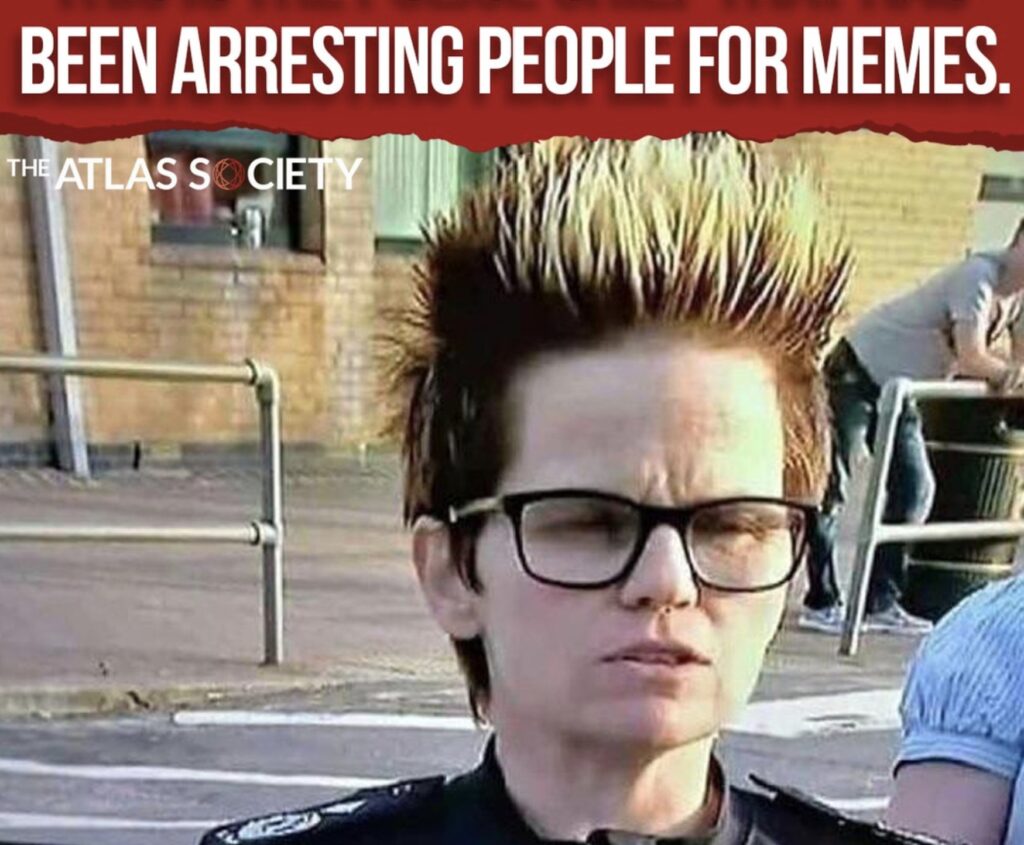
The Chief of Derbyshire police is this thing – Rachel Swann, who has achieved international notoriety for her penchance for arresting people for naughty memes.

Rachel Swann Derbyshire police chief

Note that when I use a word such as ‘obvious’ and put it in quotation marks, I do so because I have suffered from paranoid psychosis in the past, and I am aware it would not be ‘obvious’ to my doctor, for example, or at times myself (I have a duty to constantly question it and apply rigorous CBT and reality testing techniques). In no sense do I believe none of this is happening, and that I have been suffering from a delusion for the last 20 years, but rather I am pointing out that it would not possibly be a legal defence for the police to argue that I ‘know’ that they are doing this, and therefore they have not been ‘gaslighting me’ for the purposes of causing me extreme psychological suffering (i.e. torturing me). In any case, the psychopaths would still likely face charges of aggravated harassment and misconduct in public office.

Under the Criminal Justice Act of 1988, a public official such as a member of the police found guilty of psychological torture faces life imprisonment.

Tha customer services manager for Ryanair appears to be a woman named Lorraine Rothwell.

Owain Richards is now Royal Gibraltar Police Commissioner

People with severe and devasting mental illnesses in Gibraltar may want to exercise great caution in ever getting on the wrong side of the police, now that former Met Police commander Owain Richards has been made their new head. Richards was responsible for policing in West London – including Hammersmith and Fulham – when the illegal and utterly sadistic gaslighting of the Met Police was at its very worst, or at least its effect on me was at its most terrible, given that I was trying to cope with my mother’s cancer and then slow and painful death at the time. There is not a chance in hell he could not have been aware of it, greenlighting it, and likely actively encouraging it.

Psychological torture is a criminal offence in the UK under the Criminal Justice Act of 1988 that carries a life sentence if carried out by a public official, such as a police chief. It is illegal in Gibralter in the same way under the 2011 Crimes Act. In both the UK and Gibraltar, it is specified that it does not matter the nationality of the individual, nor where he commits the offence.

https://www.gibraltar.gov.gi/press-releases/owain-ceri-richards-appointed-as-royal-gibraltar-police-commissioner-2252025-10734

Eastbourne Again (Sussex Police District Commander Di Lewis)

I was recently back in the UK and spent another week in Eastbourne. If you’re wondering why I again visited this place when I have been tortured by the police there in the past, well it’s a case of ‘better the devil you know’. Even now, after 17 years, the depraved psychopathic devils still appear to be pointing me out to at least security guards (and of course, their police colleagues) wherever I visit, not only in the UK, but anywhere in Europe. So there wouldn’t be much point going somewhere else to ‘escape it’, and visiting a new place causes even more stress to my mental health, as I am wondering all the time whether the criminal psychopaths have indeed pointed me out. And besides, I like the town of Eastbourne itself, especially in the summer.

TBH, despite the city center constantly being full of agressive and violent crackies, I didn’t see much of the police in the entire week. However, whenever I did so, at least as far as the male police officers were concerned, they would make a point of grinning and smirking at me. Every single time. “There’s that nutter who thinks we’re torturing ‘im just cause we’re looking at ‘im, oink, oink. Just ‘coz he doesn’t like us looking at ‘im, oink, oink, oink.”

Literal Satanic demons.

For this reason, I am finally going to contact the Law Society this week, after 17 years.

Security guards, in general, were more circumspect, but it was ‘obvious’ that I had been pointed out to them (speaking as a paranoid schizhophrenic who has been told to my face by security guards in Eastbourne several years ago that I haven’t been pointed out to them, then marched out of the shopping center). On one occasion in the Beacon Center, a large Asian security guard deliberately veered into my path. I avoided him, but given that I’ve previously been deliberately shoulder barged by an Eastbourne Buisness Warden (ie. physically assaulted) this wasn’t very nice.

The rail staff at Eastbourne station pretty much ignored me, although they did give the odd ‘hint’ that I was still being pointed out to them.

The most disturbing thing though happened on my way out of the country at Gatwick airport. As I was walking through the South Terminal, a female police officer (or PCSO) with short dark hair, was talking to two people. As I walked past, she turned her head to stare at me, and I believe I heard her say sarcstically and quite loudly – “just looking”.

In 2025, the Eastbourne police team included: Chief Inspector Kara Tombling, Inspector Sarah Taylor, Seargent Mattie Adam, PCSO Chloe Larkin, PCSO Katie Clarke, PCSO Kirsty Gowing, PCSO Leianna Stamp, PCSO Ryan Saunders, PCSO Scott Kennedy

In 2025, the Gatwick Airport police team included: Chief Inspector Richard Church, Inspector Bex Kift, Police Sergeant Ian Hatcher, PCSO Fatima Karimova, PCSO Mark Simmonds, PCSO Matt Duvall, PCSO Sharon Ashwell, PCSO Shelley Brown, PCSO Tracy Smythe, PCSO Wendy Elliott.

Note that PCSO Wendy Elliott was present a few years ago when ‘disability rights campaigner’ PCSO Victor Finch sadistically gaslighted me as I was waiting to board my plane (doing so presumably in the knowledge that I had been similarly gaslighted by his colleagues in a dozen different countries for over a decade). I do not think she was the PCSO in the incident described above.

Under the Criminal Justice Act of 1988, a public official, such as a police officer, faces life imprisonment if convicted of (psychological) torture.

Jo Shiner Has Troll Arrested For ‘Stalking’

A few days ago I came across a headline revealing that a troll had recently been convicted of ‘stalking’ Sussex Police Chief Jo Shiner. I wonder what he could have done, I asked myself. Perhaps he had been going into shops where she lives showing security guards and staff a photograph of her, and encouraging them to mock, abuse, intimidate, gaslight, and threaten her, whilst all the time, making sure that she didn’t know what was going on, or whether she was simply suffering from a paranoid delusion? Perhaps he’d done this for nearly two decades, and also got together with some other trolls, including trolls in a dozen other European countries, and they had access to her Internet connection and could know when she had booked any travel and such, and then pointed her out to security guards and staff in shops and train stations and airports before she visited them, again with the same instructions to mock, abuse, intimidate, gaslight, and threaten her?

That would be awful beyond belief, and certainly warrant a life sentence for the depraved psychopathic sadistic troll, although clearly not as evil as doing the above to somebody who was already mentally ill to begin with and who could get no help – legal or psychiatric – because they would not be believed. Anybody even partly responsible for doing anything as unimaginably evil and depraved as that would certainly be facing life behind bars, and if they happened to be a public official – such as a police chief – then they would without doubt be facing multiple life sentences in what would assuredly be the biggest scandal in the history of the UK police. Such a police chief would (confirmed by ChatGPT) face life for (psychological) torture under the Criminal Justice Act of 1988, life under the offence of misconduct in public office, a lengthy prison term under the law on aggravated harassment, as well as likely to be sued into tomorrow under multiple serious breaches of the European Human Rights Act. ChatGPT actually likened such police behaviour to the tactics of the former East Germany’s notorious Stasi secret police agents, who would gaslight and commit ‘zersetzung‘ (psychological warfare) against individuals who threatened the Communist Party.

Oh no, but the troll did not do any of that. In fact, it appears (from the 2 or 3 articles I read), that he sent her some messages on Twitter alleging that she was corrupt, and created accounts under her name that did likewise. But in the increasingly Big Brother society of the UK in 2025, that was enough to have him convicted for stalking and committing offences under the malicious communications act.

Meanwhile, and absolutely unsuprisingly, this is what Jo’s depraved and psychopathic police officers have been getting up to recently under her command:

https://www.dailymail.co.uk/news/article-14728213/Moment-disabled-93-year-old-pepper-sprayed-Tasered-hit-baton-police-dying-three-weeks-later-threatened-care-home-staff-knife.html

Hastings (Chief Inspector Simon Yates)

I recently detailed further abuse and aggression at Eastbourne rail station. I’ve also made two visits to Hastings this year, and while I haven’t received quite the same aggression from the train station staff there, their behaviour has been odd, although not initially.

In February I spent a week there, and passed through the station a few times. There was nothing unusual or anything about the staff behaviour to even suspect that I had been pointed out to them. But on one occasion as I passed through, there were three police officers standing there for whatever reason. All three looked decidedly uncomfortable when they saw me. From that point on, the staff did start acting strangely, and on a couple of occasions aggressively. I don’t know if the police pointed me out that day or said something to the staff, or among themselves that the staff overheard, or if a staff member may simply have noticed the odd reaction of the police as I passed them.

One very strange incident took place invoving a black male staff member at the station. However, on my second visit, he ignored me whenever I saw him, so I will not detail it here, unless something changes on a future visit to Hastings.

More disturbing was my second visit to Hastings, although this time it was not the rail station staff (who all pretty much ignored me). Rather, it was the behaviour of the police themselves.

On my first or second day, I was passing through Hastings center and two male police officers passed me. They appeared to recognize me, and as I passed them, I’m sure I heard one of them call me an ‘arsehole’. 20 minutes or so later, I passed them again, and this time one of them – an Asian male – made an exaggerated show of looking suspiciously at me, then turned to his colleague and angrily said something to him, then looked back at me again.

Over the last 17 years of this, in a dozen different countries, I’ve experienced this at least a thousand times from both police and security guards. They appear to be trying to ‘tell me something’ (me, a paraonid schizophrenic). I suspect they are trying to claim that the reason I am ‘being looked at’ is because I ‘attract attention’. In other words, the reason why I’ve been apparently subjected to closer scrutiny in 12 different countries for nearly 20 years than ISIS terrorists and cartel bosses and the like, pointed out to hundreds of security guards and even shop staff who abuse, mock, and intimidate me, whilst throughout those two decades being gaslighted into believing it’s all a delusion existing inside of my head, is because….. I get slightly agitated sometimes at all of this.

Well, that’s cleared that up then! After 17 years, I finally ‘know’!!!!

According to the provisions relating to torture (including psychological torture) in the Crimanal Justice Act of 1988, a public official such as a member of the police who is convicted of the offence of torture faces a life sentence. He or she could also face life imprisonment for misconduct in public office. He or she could also face conspiracy to torture charges, as well as aggravated harassment charges. The police could also be sued for multiple serious breaches of the European Human Rights Act.

The Chief of Sussex Police is Jo Shiner. The Chief Constable for Hastings is Simon Yates.

Several times I sat outside Costa Coffee or Cafe Nero, enjoying the warm weather. Trying to relax, trying to breathe in the sea air, trying to live in the moment just briefly, trying to forget this 17+ year ‘delusion’, trying to forget my mother’s slow and painful cancer death, trying to forget my brother’s painful cancer death just several months ago. On each occasion a male and female police officer happened to stand in the center next to their mobile ‘police station’. Each time, they repeatedly looked at their watches and then sadistically grinned whilst looking in my direction or theatrically ‘looking past me’. On one occasion, the male and female officers were talking to a tattooed man who appeared to be a member of the public. As I finished my drink and walked away in the opposite direction, I heard somebody shout – “what do you think you’re doing?”.

In 2025, Hastings police team included:

District Commander Simon Yates,
Chief Inspector Matt Chapman,
Inspector Lee Torbet,
Sergeant Dave Gibbins-Jones,
PCSO John Tucker,
PCSO John Tytherleigh,
PCSO Liam Janman,
PCSO Natasha Slow,
PCSO Tom Clare

If the police really have been doing this for 20 years – pointing me out to not only their colleagues in every police force in the UK and Europe, but to security guards, shop staff, airline cabin staff etc, and done in a manner that leads them all to constantly behave in the same mocking, intimidating, or threatening way, in the knowledge that I have suffered from paranoid schizophrenia in the past, and deliberately leaving me uncertain as to whether ANY of it is real or entirely in my head – then scores of them could face life imprisonment under the Criminal Justice Act of 1988, which prohibits (psychological) torture or cruel and inhuman punishment. Not to mention convictions for misconduct in public office, stalking, aggravated harassment, and even disability hate crime.

According to legal advice I have received, given the sheer number of members of the public they appear to have involved directly in this over two decades, there could even be case for prosecuting them for crimes against humanity.